 THE 8.5 HOUR ATHLETE RECOVERY SLEEP PROGRAM
 Listen on Spotify ↗
 Listen on YouTube ↗
YOUR NEXT PR
STARTS THE NIGHT BEFORE.
Scroll left to explore the full graph
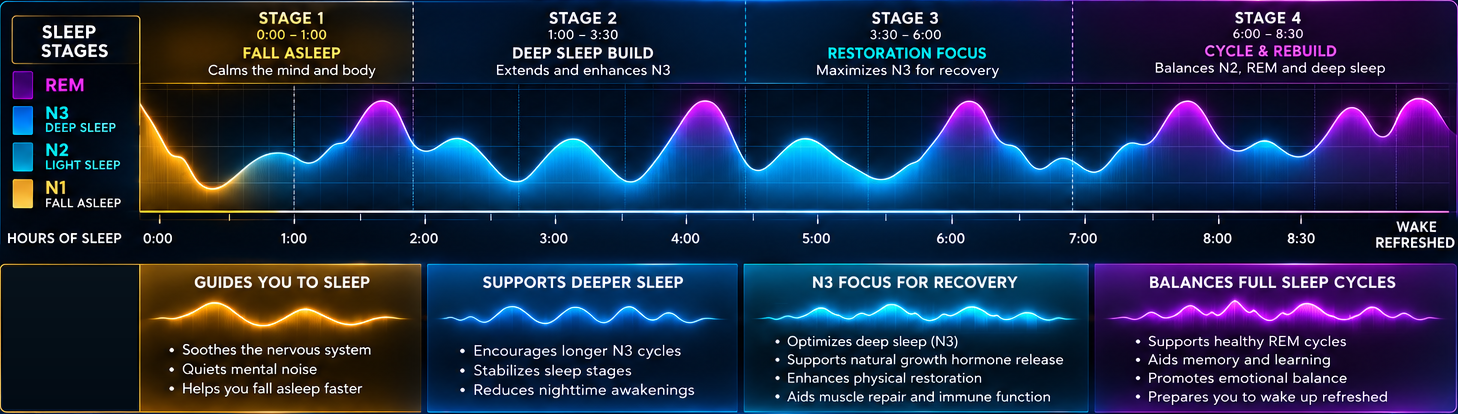
Illustrative program artwork; sleep-cycle and recovery outcomes are not established.
REST. RECOVER. PREPARE FOR TOMORROW.
PHYSICAL
GROWTH HORMONE
& SLEEP
IMMUNE
FUNCTION
MEMORY
& LEARNING
MOOD & MENTAL
RESILIENCE
ATHLETIC
PERFORMANCE
THIS ISNT JUST WHITE NOISE
LEARN MORE ABOUT THE SCIENCE BEHIND SLEEP PR
Explore the science ↓☾WIND DOWN
↻MAKE A ROUTINE
✧REST & RESET
THE SCIENCE BEHIND SLEEP PR
Sleep is part of the training process.
Explore sleep architecture, athletic recovery, and the research that inspires the SLEEP PR audio experience.
Training Creates the Challenge. Sleep Supports the Adaptation.
Every athlete understands the importance of training. Whether you're lifting weights, running, cycling, competing, or preparing for your next personal record, physical training challenges the body.
Muscle fibers experience mechanical stress. Energy stores are depleted. The nervous system is challenged. Your body responds to these demands through a complex process of repair, recovery, and adaptation.
But training alone doesn't make you stronger.
The improvements you're working toward depend on how effectively your body recovers from that training.
And one of the most important components of that recovery is sleep.
During sleep, the body coordinates numerous biological processes involved in tissue maintenance, energy regulation, immune function, memory consolidation, and physical recovery.
For athletes, sleep isn't simply time away from training.
Sleep is part of the training process.
Understanding the Architecture of Sleep
Sleep isn't one continuous state. Throughout a typical night, the brain progresses through several distinct stages, each associated with different patterns of brain activity and physiological function.
These stages are organized into repeating cycles of non-rapid-eye-movement (NREM) and rapid-eye-movement (REM) sleep.
Sleep cycles repeat throughout the night, and their length varies across people and across the night.
The four commonly recognized sleep stages are:
N1 — The Transition Into Sleep
N1 is the lightest stage of non-REM sleep. Brain activity begins to slow, muscle activity decreases, and the body transitions from wakefulness into sleep.
N2 — Stable Sleep
N2 is characterized by distinctive brain activity, including sleep spindles and K-complexes. It occupies a substantial portion of a typical night's sleep and is involved in sleep stability and memory-related processes.
N3 — Deep, Slow-Wave Sleep
N3 is the deepest stage of non-REM sleep and is characterized by prominent slow-wave brain activity.
It is particularly important to our understanding of physical restoration because of its relationship with physiological recovery processes and the body's natural secretion of growth hormone.
REM — Rapid Eye Movement Sleep
REM sleep is associated with vivid dreaming, distinctive brain activity, and processes involved in memory and emotional regulation.
All four stages contribute to healthy sleep. Rather than focusing exclusively on one stage, the goal is to respect the natural organization of sleep across the night.
N3 Deep Sleep: The Recovery Connection
For athletes, N3 slow-wave sleep deserves particular attention.
During N3, the brain produces large, synchronized slow waves. These are associated with low-frequency activity in the delta range, commonly described as approximately 0.5–4 Hz.
N3 sleep is generally concentrated in the earlier part of the night, particularly during the first several sleep cycles.
This timing is important.
Research has established a close relationship between the onset of slow-wave sleep and one of the body's largest natural pulses of human growth hormone.
Growth hormone plays important roles in tissue maintenance, protein metabolism, and normal physiological repair.
Its secretion is regulated by multiple factors, including age, exercise, nutrition, and sleep.
The relationship between N3 and growth hormone is one reason deep sleep has become such an important topic in sports science and athletic recovery.
For athletes, protecting healthy deep sleep is an important part of protecting recovery.
The Connection Between Sleep and Human Growth Hormone
Human growth hormone, commonly abbreviated HGH or GH, is naturally produced by the pituitary gland.
It participates in several biological processes relevant to physical development and maintenance, including protein metabolism and tissue repair.
In healthy adults, a substantial pulse of growth hormone commonly occurs shortly after sleep begins, often in association with the first major period of slow-wave sleep.
This relationship has been demonstrated in physiological sleep research.
It does not mean that every minute of N3 produces the same amount of growth hormone, or that artificially increasing delta-frequency sound will necessarily increase HGH.
Instead, it illustrates an important principle:
The natural organization and quality of sleep are closely connected with the body's recovery-related hormonal processes.
For athletes who spend significant time optimizing training, nutrition, and supplementation, sleep represents another essential component of the overall recovery equation.
Why Sleep Changes Throughout the Night
One of the most interesting characteristics of human sleep is that its structure changes as the night progresses.
During the first third of a typical night's sleep, N3 slow-wave sleep tends to be more prominent.
As the night continues, periods of deep sleep generally become shorter, while REM periods tend to become longer.
This progression is influenced by the interaction of sleep pressure, circadian rhythms, and other biological regulatory systems.
It also explains why a full night's sleep matters.
Early-night sleep and late-night sleep are not interchangeable. They contain different proportions of sleep stages, all of which contribute to normal functioning.
SLEEP PR takes inspiration from this natural overnight progression.
How SLEEP PR Is Designed
SLEEP PR is an 8.5-hour, 44-track sleep audio experience developed with athletic recovery in mind.
Rather than using one identical sound for the entire night, the program follows an evolving audio structure inspired by the way sleep stages naturally change.
The program incorporates a gentle noise-based soundscape and subtle rhythmic audio modulation, with an emphasis on slower, delta-inspired patterns during the earlier portions of the experience.
As the night progresses, the audio evolves to reflect the changing balance of sleep stages, including the increasing prominence of REM sleep later in a typical night.
The objective is to provide a consistent, comfortable listening environment while giving the program a purposeful overnight structure.
Early Night — Preparing for Rest
The opening portion of the program is designed to establish a calm, stable audio environment as the listener settles into sleep.
N2 — Supporting a Consistent Sleep Environment
The audio maintains a gentle, continuous character intended to minimize distracting changes in the listening experience.
N3 — The Deep-Sleep-Inspired Focus
The program places particular emphasis on slower rhythmic patterns inspired by the delta-frequency activity associated with N3 slow-wave sleep.
This is the scientific inspiration behind SLEEP PR's recovery-focused design.
Later Night — An Evolving Soundscape
As the program continues, the audio transitions through later-night sections inspired by the changing architecture of natural sleep, including the increasing importance of REM periods.
Together, these sections create a continuous overnight listening experience rather than a collection of unrelated sleep sounds.
Why Sound?
The environment in which we sleep can influence our ability to fall asleep and remain asleep.
Unpredictable environmental noise, sudden changes in sound, and other disturbances may interrupt sleep.
Consistent background sound is sometimes used to help mask these disturbances and create a more predictable acoustic environment.
Research into pink noise and auditory stimulation has also explored whether certain sounds can influence aspects of sleep physiology.
Some experimental studies have reported changes in slow-wave activity or sleep-related outcomes under specific conditions.
However, findings are mixed, and many promising experiments use precisely timed stimulation synchronized to measured brain activity.
Those laboratory techniques differ from a prerecorded overnight soundtrack.
SLEEP PR draws inspiration from this field of research while focusing on a practical listening experience that athletes can incorporate into their nighttime routines.
Recovery Is More Than One Sleep Stage
Although N3 is central to the SLEEP PR concept, healthy athletic recovery depends on more than deep sleep alone.
Adequate sleep duration, regular sleep schedules, and the natural progression through NREM and REM stages all matter.
Sleep supports processes involved in:
- Physical restoration and tissue maintenance
- Hormonal regulation
- Immune function
- Learning and memory consolidation
- Attention, reaction time, and cognitive performance
- Overall readiness for training and competition
No audio program can replace adequate sleep opportunity, good sleep habits, nutrition, or an appropriate training and recovery plan.
But a consistent bedtime routine and a comfortable sleep environment can be useful parts of a broader recovery strategy.
Built for Athletes Who Take Recovery Seriously
Athletes measure nearly everything.
Training volume. Heart rate. Pace. Power. Strength. Calories. Protein. Recovery scores.
Yet sleep is sometimes treated as whatever time remains after everything else is finished.
SLEEP PR was created around a different philosophy.
Recovery deserves the same intention as training.
Our 8.5-hour audio experience brings together a structured overnight soundscape, an appreciation for natural sleep architecture, and a particular interest in the restorative importance of N3 slow-wave sleep.
It's an invitation to approach the night with the same purpose you bring to your training.
Because improvement isn't determined only by how hard you work.
It's also influenced by how well you recover.
TRAIN WHILE YOU SLEEP.
YOUR NEXT PR STARTS THE NIGHT BEFORE.
Scientific note: The importance of sleep for athletic recovery and the association between N3 slow-wave sleep and natural growth-hormone secretion are established areas of research. SLEEP PR is a science-inspired audio experience; its specific effects on N3 duration, growth-hormone secretion, or athletic performance have not been clinically established.
Further reading
NIH: Sleep stages ↗Ngo et al. (2013): Closed-loop auditory stimulation ↗Besedovsky et al. (2017): Slow oscillations and sleep physiology ↗These sources describe sleep biology and laboratory research, not clinical testing of SLEEP PR.
SET THE SCENE
THE NIGHT, ON SCREEN.
If the embedded player is unavailable, watch directly on YouTube ↗.